
A nagauta masterpiece in which a white heron appears as a girl and dances the pain of love. From a silent opening all in white, to a quick change into a bright town girl, to the torments of hell, the scenery and the heart change completely within one piece. It is known as a great work that tests the full range of a dancer's expression.
- Japanese title
- 鷺娘 (Sagi Musume)
- Music
- Nagauta
- Season
- Winter
- Characters
- The spirit of a white heron, as a girl
- Premiere
- 1762, Ichimura-za theatre, Edo
- Lyrics by
- Unknown (sometimes attributed to Horikoshi Nisōji)
- Music by
- Kineya Chūjirō (some sources say together with Fujita Kichiji I)
- Choreography
- Nishikawa Senzō II
Background
In 1762, at the Ichimura-za in Edo, the great female-role actor Segawa Kikunojō II danced it as one part of a quick-change dance (most sources say five changes). The Nishikawa school records that the original choreography was by Nishikawa Senzō II, so it is a work closely tied to the Nishikawa school.
After that it fell out of the repertoire and its movements were lost, until Ichikawa Danjūrō IX revived it in the Meiji era and laid the foundation of today's form. The ending, in which the heron spirit loses her strength and dies, is said to have been added by Onoe Kikugorō VI after he saw Anna Pavlova dance The Dying Swan.
Story
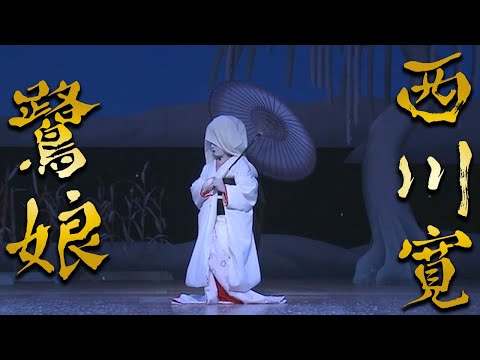
In a landscape covered with snow, a girl stands alone under a janome umbrella, dressed in a pure white kimono and a white silk hood. She is the spirit of a white heron, troubled by a love that piles up in her heart like silently falling snow.
In an instant the white kimono becomes a colourful long-sleeved one, and she becomes a town girl. She shows a girl's heart in love with a hand towel, dances to popular songs and twirls umbrellas in a dance full of umbrella words. But before long she turns back into a heron. For the sin of an impossible love she suffers the torments of hell, and struggling, she dies in the falling snow. (Endings vary: in some productions she strikes a final pose standing on a platform.)
Highlights
- The entrance in the snow: all in white, with hood and umbrella. Small movements of the neck and shoulders hint at a bird, in a quiet, dreamlike opening.
- Hikinuki: stage assistants pull out threads and the costume falls away, changing white to bright colour in a moment. The most dazzling moment of the piece.
- Bukkaeri: near the end the upper part of the costume is turned down to show she has returned to her true form as a heron.
- The kudoki: a girl's shyness and longing, danced tenderly.
- The umbrella dance: parasol, flower hat, wheel umbrella: a bright, light dance on umbrella words.
- The torments: back in heron form, she struggles under the torments of hell until her strength fails. A striking contrast with the quiet opening.
Costume and props
She enters in a white long-sleeved kimono with a black obi, a white hood and a janome umbrella, then changes by hikinuki into bright kimono. Props such as a hand towel and parasol change from scene to scene.
On stage
At the Recommended Masters' Dance Festival organised by the Tokyo Shimbun, National Theatre, Large Hall.
Watch Kan Nishikawa's performance
The song lyrics (in Japanese) are on the Japanese page.